Monday, July 11, 2011

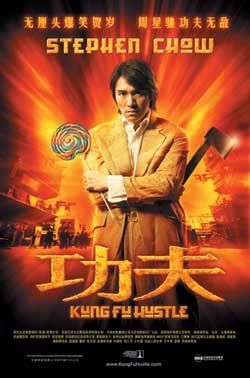
Kung Fu Hustle (2004).


Much like Chow's previous film Shaolin Soccer, Kung Fu Hustle incorporates significant use of the mo lei tau comedy style that is hugely popular amongst Hong Kong audiences. In addition to this, an almost Looney Tunes style of comedy is also added to its mix, which consequently results in the humour of this film to venture towards that of violent slapstick. That's actually a good thing - Chow has the ability to make violent scenes like for example, having a head being brutally punched into the ground, seem funny without making you feel emo. Not only that, not one scene in Kung Fu Hustle can be placed into the dull category. In essence, every scene will have something to keep you on your toes, at least that was how I felt the first time I saw this film.

Kung Fu Hustle is set in pre-revolutionary China, where the plot revolves around the Axe Gang (visualise Kill Bill's the Crazy 88 performing on a Broadway show and you got the Axe Gang) and its dominance over a Chinese city that looks much like pre-revolutionary Shanghai. However, they encounter Pig Sty Alley - a very poor district that they have not yet claim dominance over. Hence due to their superiority complex, they are determined to take over it, despite it being a place that houses a number of Kung Fu masters that always seem to beat the crap out of the Axe Gang every time they arrive. Amongst this story also lies a plot that revolves around Sing (Stephen Chow) and his sidekick Bone (Lam Chi-chung) and their desire to join the Axe Gang. Yet as the story progresses, Sing experiences a crisis of identity, as well, debates over which side to be on: the good or the bad. His choice of good leads him to undergo Kung Fu enlightenment with added Goku, as well as a showdown with the Beast (Bruce Leung). The plot of Kung Fu Hustle is difficult to describe, which is a recurring criticism made by many over this film. However, this film does not pretend to rely on a coherent plot to make it work, but rather it is its special effects, kung fu acrobats, mo lei tau comedy and its general silliness, that makes this film a great film to watch.

What I also like about this film is the fact that it has the ability to blend its extreme comedy with tender and endearing moments, thus illustrating Chow's significant directorial skills. One such example is the scene depicting Sing and the mute vendor girl, a tender moment in an otherwise very mo lei tau styled film. The scene of where Sing holds the mute vendor girl towards him and threatens her with a knife is juxtaposed with a poster behind them of Fred Astaire and Ginger Jones in a similar, but dancing position. This is a tender scene that is also funny in a subtle way and is a clear exemplification of Chow's unique ability to neatly blend his usual extreme comedy with soft moments.

Another thing I like about Stephen Chow, apart from his clever use of extreme slapstick humour, is that he can also make what are otherwise small details, funny. For example, the last scene with the little boy licking his lollypop is made funny with the all too clear depiction of his runny, snotty nose. Another scene for example, is the scene where the mute vender girl approaches Sing's lollypop shop. Yet, this poignant scene is set alongside with the depiction of Bone's frustration of the kids wiping their snot on to the glass, as well as a depiction of him reprimanding a kid to put his pants back on. This consequently adds a subtle sense of humour to the scene and stops it from being overly poignant. Again, this is another neat example of Chow’s ability to mix funny moments with tender moments, and illustrates all to well, his status as a consummate comedy filmmaker to both Asian and Western audiences.

Saturday, July 9, 2011

Pulp Fiction (1994).

I would unashamedly say that the first time I saw Pulp Fiction from beginning to end was just three weeks ago. As such, I can almost visualise the Tarantino fans out there screaming out blasphemy and getting ready to smack the back of my head for my initial ignorance of Tarantino films. So now that I have seen Pulp Fiction, my first reaction when I saw this movie was this: this is one of the best movies I have seen in my life. Period. I mean the style of this film, the dialogue, the...everything, is simply brilliant. It goes to show you that having massive amounts of CGI and 3D with a $100 million plus budget are not substitutes for great scriptwriting, story-telling and character development. (Transformers 3 is such a film where stunning CGI and a massive film budget can still result in a shitacular film. Yeah, I just want to put it out there that I absolutely hated Transformers 3. Period).

The film essentially presents the stories of different characters in the film, ranging from store thieves, mobsters, as well as the odd drug dealer. The narrative is non-sequential - a typical Tarantino schtick, and much of the film is divided into chapters, another unique Tarantino characteristic. The use of chapters is good in that the emphasis is placed on the story of the characters and their motives, which provides a unique viewing experience that digresses from the usual following-the-story-line-from-beginning-to-end sort of movie. The use of chapters, as well as characters that derive from the fringes of society, supports the idea behind the title of the film (Pulp Fiction).

There is no singular memorable scene in this movie, every scene in this movie should be considered as a memorable scene. As a result of the stylish and often times, humorous dialogue, Pulp Fiction is one of the most quotable films out there. Take this line uttered by Marcellus Wallace the mob boss (Ving Rhames) to Butch the boxer (Bruce Willis) for example: "The night of the fight, you may feel a slight sting. That's pride fucking with you. Fuck pride! Pride only hurts. It never helps. You fight through that shit." This is only just one example of a memorable line in Pulp Fiction, in which there are numerous in the film. Other than the entertaining dialogue, Tarantino makes great use of music; every piece of music compliments extremely well with a scene. After watching this film, as well as Kill Bill, I have concluded that Tarantino is the man in choosing the right music for the right scene.

I'll also like to add that what makes this film great are the little things. It is the attention to minute detail in the film, as well as the use of unique episodic moments, that just adds that little spark that sets Pulp Fiction apart from other movies. Like the famous dance scene between Uma Thurman and John Travolta. It doesn't advance the plot or add anything to the overall progression of the story, but it sure is fun to watch.

I've posted a video of the film's memorable dance scene for your enjoyment :)


Friday, July 8, 2011

School of Rock (2003).

Now I love this film. Apart from being an all round funny family movie, this is one of my favourite movies of all time because this is the film that has made me the hard/classic rock fan that I am today. Additionally, this is the film that solidified my love of all things Deep Purple (they're a band, in case you didn't know), a love that first started roughly when I was Grade 5. I was a fan of Deep Purple before this movie came out, but it is because of this movie that led me to change from being a secret fan of Deep Purple into a not so secret fan of Deep Purple.

Essentially, the main plot of the film follows a rock singer and guitarist named Dewey Finn (Jack Black), where as a result of his expulsion from his band, disguises himself as a substitute teacher and subsequently forms his own band comprising of the musically talented students of his class in his quest to win the Battle of the Bands. All this happens as a result of his initial goal of finding a way to pay his rent for his apartment.

Jack Black is what makes this film work. Sure the music is a big factor in the success of this film, but without Black, there would had been a void in this film that seemingly could not have been filled. In this rock film, Black's character not only encompasses his own typical personality traits, but additionally echoes traits that can be found in larger than life rockers such as Angus Young, Bon Scott, Ian Gillan and Meat Loaf. And he does this very well.

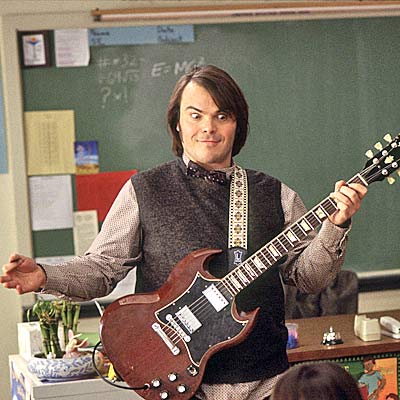
Jack Black and his death stare.
As well, this film has an underlying message that midway in the film, is uttered emphatically by Finn. And the message is this: stick it to the man. Rock music is all about sticking it to the man, according to Finn. In a funny scene, Finn falsely says in front of the Battle of the Bands judge that the kids are suffering from stick-it-to-the-man-neosis in an attempt to enter in the competition. This is perceived as being a serious blood disease by the judge, and the band was then subsequently able to participate in the competition. And with that note, I am ending this paragraph by saying that thankfully both in the movie and in real life, stick it to the man is not a disease, but a cure.

Friday, July 1, 2011

The Truman Show (1998).

One of the most thought provoking and thematic films I have seen, The Truman Show is one of my favourite films as it is a film that questions existentialist ideas and social realities, as well as providing a critique on our obsession for voyeurism and celebrity culture. In addition, many socio-political ideas can be discerned in the film.

Directed by Peter Weir and written by Andrew Niccol, the film tells of a man, Truman Burbank (Jim Carrey), and how he is completely unaware that his life is artificially constructed by a reality television show called 'The Truman Show,' a show that is broadcast 24 hours a day throughout the globe. Over the course of the film, Truman becomes suspicious of the constructed life he lives in and subsequently seeks the meaning and truth of his life.

The film is an intensely thematic film that brings about to the audience many questions about social realities. In essence, this film is a critique on the statement 'ignorance is bliss.' Does the seemingly perfect nature of the Seahaven, the world in which Truman lives in, justify Truman's ignorance of the real world and its unappealing realities? Does living in a utopia-like setting justify not knowing what the real world is capable of, for better or worse? It can be said that this film provides allusions to real world regimes, such as North Korea and the ignorance of its people of the actions of its government, as well as the nature of the rest of the world. But unlike North Korea, the creator of 'The Truman Show,' Christof, in actuality, does indeed create Seahaven as being the perfect world. Rather than fear and dictatorial methods, Christof makes use of the falsely constructed world and sophisticated illusory methods, such as subtle propaganda to induce a fear of water in Truman in order to not only physically imprison him in Seahaven, but psychologically as well. This is evident in Christof's interview statement that '[Truman] can leave at any time.' Yet Christof knows he won't. Thus, Truman is just as much trapped in his ignorance as much as he is trapped in the Seahaven TV setting. In addition, the poignant scene of where Truman's best friend Marlon, explains to an emotional Truman that he'll 'gladly step into traffic for [Truman],' is consequently undermined by the fact that Marlon's lines are uttered in his ear by Christof. This eerily depicts Christof's disturbing ability to comprehend and pick out Truman's psyche, which is on par with that of a best friend and clearly illustrates the psychological power that Christof has over Truman.

The film also gives a critique on societies obsession towards celebrity culture. The scenes of the viewers of 'The Truman Show' and their obsession with the show is comparable to our obsession with celebrities and their lives. The pictures and badges seen in the homes of those viewers, in addition how each scene of the viewers seemingly depicts them as if they have been intensely watching the show non-stop over the course of the film, exemplifies our constant exposure to to the lives of celebrities and our liking for it. The fact that Charlie Sheen garnered 1 million followers on his Twitter account in a day, illustrates our petty desire to know the very intricacies of the lives of our celebrities. The ability for 'The Truman Show' to grasp the attention of the whole world alludes to the power of the media and its status in society. The government can make laws and rules to instigate societal control, but it is the media that can influence the very minds and hearts of the people. Maybe the film is also contending that apart from Truman, our lives are also controlled by the media.

In addition to the themes, the highly effective use of music aids the ideas espoused in the film. The use of Mozart's blissfully cheerful 'Rondo Alla Turca' played on piano in the scenes of where Truman walks to work, truly ignorant of the falsities of Seahaven and his life, supports the notion of ignorance being 'blissful.'

In the first scene, Truman looks into the mirror (and directly to the audience) where he is pretending to be a mountain climber and says 'if I'm not going to make it, you going to have to go on without me.'  Maybe he is saying to the audience without knowing, that if he doesn't free himself from his TV world, maybe we, the audience, can instead.