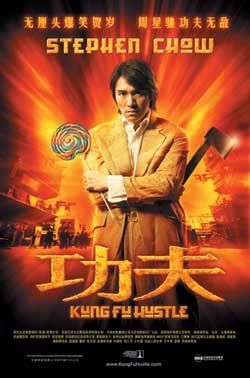
Much like Chow's previous film Shaolin Soccer, Kung Fu Hustle incorporates significant use of the mo lei tau comedy style that is hugely popular amongst Hong Kong audiences. In addition to this, an almost Looney Tunes style of comedy is also added to its mix, which consequently results in the humour of this film to venture towards that of violent slapstick. That's actually a good thing - Chow has the ability to make violent scenes like for example, having a head being brutally punched into the ground, seem funny without making you feel emo. Not only that, not one scene in Kung Fu Hustle can be placed into the dull category. In essence, every scene will have something to keep you on your toes, at least that was how I felt the first time I saw this film.
Kung Fu Hustle is set in pre-revolutionary China, where the plot revolves around the Axe Gang (visualise Kill Bill's the Crazy 88 performing on a Broadway show and you got the Axe Gang) and its dominance over a Chinese city that looks much like pre-revolutionary Shanghai. However, they encounter Pig Sty Alley - a very poor district that they have not yet claim dominance over. Hence due to their superiority complex, they are determined to take over it, despite it being a place that houses a number of Kung Fu masters that always seem to beat the crap out of the Axe Gang every time they arrive. Amongst this story also lies a plot that revolves around Sing (Stephen Chow) and his sidekick Bone (Lam Chi-chung) and their desire to join the Axe Gang. Yet as the story progresses, Sing experiences a crisis of identity, as well, debates over which side to be on: the good or the bad. His choice of good leads him to undergo Kung Fu enlightenment with added Goku, as well as a showdown with the Beast (Bruce Leung). The plot of Kung Fu Hustle is difficult to describe, which is a recurring criticism made by many over this film. However, this film does not pretend to rely on a coherent plot to make it work, but rather it is its special effects, kung fu acrobats, mo lei tau comedy and its general silliness, that makes this film a great film to watch.
What I also like about this film is the fact that it has the ability to blend its extreme comedy with tender and endearing moments, thus illustrating Chow's significant directorial skills. One such example is the scene depicting Sing and the mute vendor girl, a tender moment in an otherwise very mo lei tau styled film. The scene of where Sing holds the mute vendor girl towards him and threatens her with a knife is juxtaposed with a poster behind them of Fred Astaire and Ginger Jones in a similar, but dancing position. This is a tender scene that is also funny in a subtle way and is a clear exemplification of Chow's unique ability to neatly blend his usual extreme comedy with soft moments.
Another thing I like about Stephen Chow, apart from his clever use of extreme slapstick humour, is that he can also make what are otherwise small details, funny. For example, the last scene with the little boy licking his lollypop is made funny with the all too clear depiction of his runny, snotty nose. Another scene for example, is the scene where the mute vender girl approaches Sing's lollypop shop. Yet, this poignant scene is set alongside with the depiction of Bone's frustration of the kids wiping their snot on to the glass, as well as a depiction of him reprimanding a kid to put his pants back on. This consequently adds a subtle sense of humour to the scene and stops it from being overly poignant. Again, this is another neat example of Chow’s ability to mix funny moments with tender moments, and illustrates all to well, his status as a consummate comedy filmmaker to both Asian and Western audiences.